OACC / CABC OACC - Organic Agriculture Centre of Canada
OACC homepage

Soil Tests in Organic Systems

Av Singh, Ph.D.

You'd be hard pressed to find any farmer who wasn't familiar with the notion of soil testing. It's the creed for most agricultural extensionists and crop consultants. Soil test. Soil test. Soil test. Yet surprisingly, for many producers, including organic farmers, the management practice of regular soil testing (once every 3 to 4 years) is not common. Attempting to explain the relatively poor adoption of soil testing practices include several reasons. A minority of producers do not link the potential economic benefit of catering your fertility regime to soil test recommendations, and therefore view soil testing as an additional expense. Many producers find it difficult to interpret soil test lab reports, while many organic producers find conventional soil test lab reports frustrating because they are not practical for their production systems. Similarly, many long-term organic producers find conventional soil tests limiting and a superficial assessment of soil health and a poor indicator of crop production potential.

Despite these valid reasons (and some poor excuses) the current draft of the National Organic Standards (click here to view the draft standards), mandates soil testing every three years. Currently, mandatory soil testing is a requirement for some organic certifying bodies, while others often require soil sampling less frequently, such as when first applying for certification, or only when a field is being brought in for production. This article overviews some general soil testing principles and highlights potential advances in soil health assessment for organic producers.

What do I need to take a soil test?
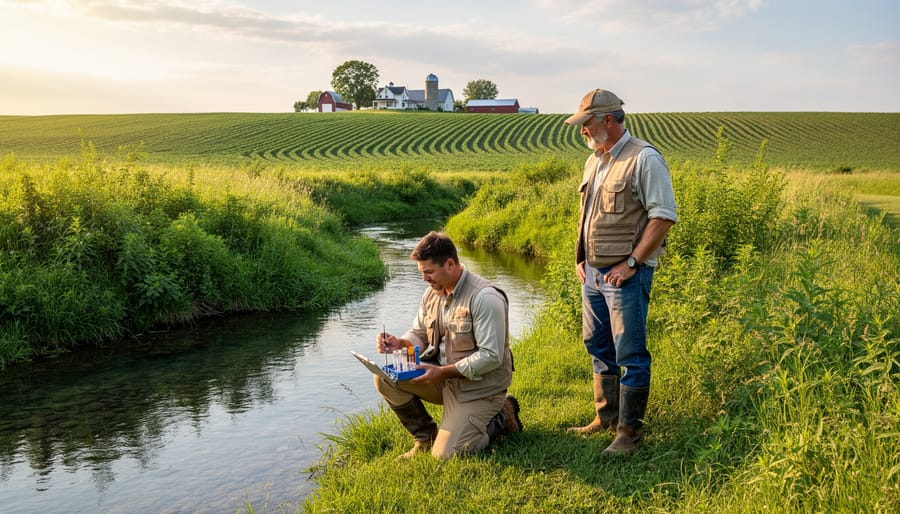
Collecting the soil sample is one of the most important steps in conducting a soil test. The equipment typically required includes a soil probe or shovel, a bucket (preferably made of plastic or non-galvanized metal), boxes or bags (often provided by soil test labs), and a waterproof marker for labeling. If boxes aren't available Ziploc bags are suitable.

How many samples are enough?
A soil sample is most effective when it accurately represents the area of the soil being sampled. Composite samples of several individual samples within a field area are a good way to obtain representative samples. Sample cores should be collected to a plow depth from 15 to 20 random spots for every 20 acres. Avoid sampling near roads, fencerows, highly eroded areas, etc. Do not include soil from both high yielding areas and low yielding areas in the same composite sample, as recommendations for these areas would vary. This may seem very tedious, but keep in mind that this little 1 kg sample is representing over 20 million kg of soil.

The depth of sampling is somewhat dependent on field management practices. If the field is to be worked only the top two inches or is pastureland then a 10 cm (4-inch) sampling depth is adequate. For soils worked or tilled, the proper sampling depth would be just less than 15 cm (6 ¾ inches). Soils will generally drop in terms of fertility the deeper you go. So samples taken too deep may make it appear you need more fertility than is truly the case.

When and how often do I take my samples?
A soil sample every 3 or 4 years may be sufficient to provide general indication of fertility, but will not provide detailed analysis for very specific management decisions. If you want to monitor soil improvement of a particular area or are attempting to produce a very high quality product then more frequent soil testing would be recommended. The draft standards require soil tests every three years, but remember taking the soil test is only half the battle. If producers haven't taken the time or don't have the money to implement initial soil test recommendations, then don't waste more time and money on taking more soil tests.

Frequency of sampling is also dependent on soil type, crop rotation, and climatic factors. Sandier soils have greater fluctuations in nutrient levels and require more frequent soil tests. Crops such as silage corn and alfalfa remove large quantities of potassium, requiring more soil sampling. Crops grown under irrigation require more frequent sampling, so you might think the converse would be true for soils under drought conditions. Actually, droughty soils require frequent soil testing because of the variability in the uptake of available nitrogen.

Soil can be tested at any convenient time, but is done primarily in the fall after harvest. Testing in the fall permits enough time to get the analysis back from the lab and make plans for the next growing season. Often organic producers alter their crop rotation or choose to include green manures and underseeded crops in response to soil tests.

How do I interpret my results?
The standard soil test (readily available through university, provincial government, or commercial labs) provides data on soil nutrient levels (N,P,K, Ca, Mg) and a few soil chemical characteristics (soil organic matter, pH, base saturation, and cation exchange capacity). These parameters form the basis of fertilizer and liming recommendations for a subsequent crop. However, translating the results of a standard soil test into useful organic fertilizer recommendations is not a simple matter. In the US, there are several private labs and a few public labs that are issuing organic recommendations or formulas to help convert conventional recommendations into organic management. Towards this end, the PEI Department of Agriculture and Forestry has initiated a program to help organic producers develop an organic nutrient management plan based on fertility recommendations using only certified organic amendments. The trial will have an additional benefit of sourcing allowable inputs such as fish meal, crab meal, fish meal, etc.

Many organic producers view standard soil tests as "treating the symptom" management, and desire better evaluation tools that can help assess whether their farming practices are leading to a healthy soil system. Increased awareness of the importance of measuring non-chemical parameters has led to several on-farm test kits and testing equipment. On-farm soil test kits capable of assessing soil respiration, infiltration, bulk density' electrical conductivity, soil pH, soil nitrate, aggregate stability, soil slaking, earthworm activity, topsoil depth, compaction, root development, water salinity, and nitrate/nitrite levels in water, are available in the US. In reviewing the diversity of the above soil quality parameters, it is clear that the crop productivity is not the only factor. The soil's ability to resist erosion, buffer pollutants, and cycle nutrients are also important in assessing soil health.

There is an additional benefit in promoting non-chemical indicators of soil health. The standard soil test has effectively demonstrated the importance of macronutrients in crop productivity. Increasing farmer knowledge about soil parameters such as biological activity and soil structure may lead to more innovative farming practices that promote a well-balanced soil system.


For more information please call the Organic Agriculture Centre of Canada at 902-893-7256 or email oacc@nsac.ca.


en français

Top

© 2010, Organic Agriculture Centre of Canada (OACC)