Organic Agriculture Centre of Canada (OACC) OACC - Organic Agriculture Centre of Canada
OACC homepage

Frequently Asked Questions: Organic Field Crops Section

GrainCereal Grain Crops:

Ask Our Experts - send your question to our helpdesk. We will find the expert to respond to your question within a week of submission.

What criteria should organic producers use to choose a grain crop cultivar?
Producers should select varieties with resistance to pests and diseases that are prevalent in the region. Choosing disease resistant varieties is an important first step when selecting varieties because the use of synthetic fungicides is prohibited in organic agriculture. However, organic producers must ensure that resistant cultivars are not genetically modified. At the same time, producers must look at traits other than disease resistance. Environmental adaptation is paramount when selecting a crop or cultivar, as plant injury or death from disease is often associated with plants being weakened by environmental stress. For example, alfalfa plants killed by crown rot have often been damaged by winter injury and are therefore weakened and susceptible to disease attack.

Producers should select a seed source that is clean and disease free (certified organic if available). If saving seed it is crucial that the seed be collected from areas in which weeds and diseased plants have been carefully removed (rogue) from the field. In the near future (December 31, 2003 for Europe), all seed for organic agriculture must come from organic propagation, so it may be proactive to begin saving and cleaning your own seed.

Producers should select varieties for agronomic traits that may contribute to a value-added product or a beneficial by-product. An example of how organic systems have different selection priorities than conventional systems is seen in the preference of organic farmers for taller grain varieties that produce more straw. Straw is a valuable commodity for organic producers. Most recent plant breeding efforts, however, have been directed towards the development of shorter or dwarf grain varieties in order to reduce lodging.

Are there special considerations for grain storage on certified organic farms?
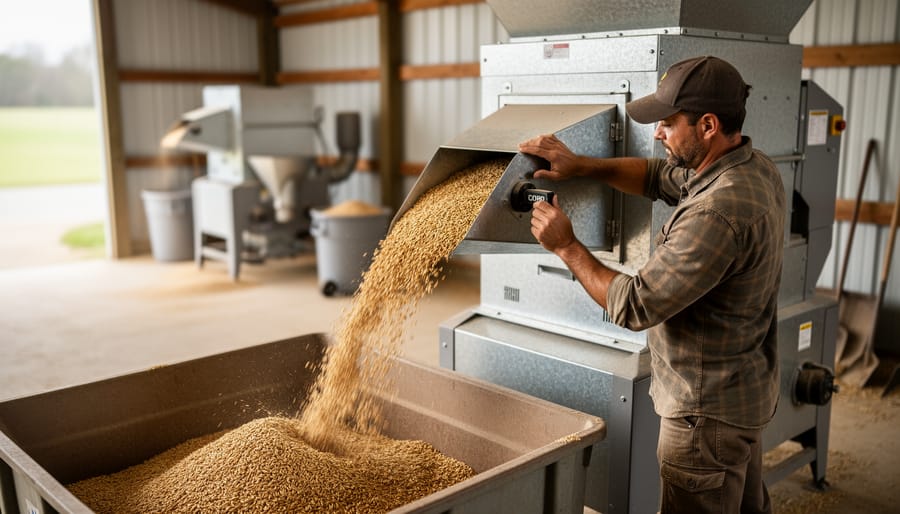
In general grain storage is similar on organic farms and conventional farms. There are some restrictions including products used for pest control. According to the National Standard of Canada for Organic Agriculture (1999):

  • 9.2.1 Storage containers should only have approved (food grade) coatings, paints, or other coverings, on surfaces that may come into contact with food or livestock feed.
  • 9.2.2 To prevent commingling during storage, bulk or unbound organic products shall be segregated from non-organic products.
  • 9.2.3 Bulk storage facilities shall be free of all non-organic product residues.
  • 9.2.4 Storage sites shall be equipped, maintained and cleaned using methods appropriate for the organic products being stored.

Can organic and conventionally produced products be stored together?
Many certifying bodies permit an operation to convert only a proportion of their farm to organic. This is called parallel production and has many strict standards that regulate the production, harvest, storage, and marketing of organic products. A detailed audit trail must be produced to ensure that the organic and conventional systems do not overlap. In organic storage and transport products must be dedicated to only organic and clearly labelled as such.


Top of Page

© 2006, Organic Agriculture Centre of Canada (OACC)