OACC / CABC OACC - Organic Agriculture Centre of Canada
OACC homepage

Alberta Organic Grower Earns Outstanding Title

By John Dietz

Switching to organic production techniques can help a farm survive and even prosper. It also can be complicated. This Alberta grower, chosen as 2003 Outstanding Young Farmer of the Year, tamed the weed problem with intercropping and an on-farm cleaning mill.

Steven close in rye
Steven close in rye

President of his district Ag Society, Olds College graduate 1990, Alberta's Outstanding Young Farmer of the Year (2003), all apply to Steve Snider of Edberg, Alta.

Add one more characteristic - committed organic grains farmer.


Steve, along with members of his family, operates Little Red Hen Mills (LHRM) near Camrose. Steve has been practicing organic cropping methods since 1986. An active speaker, he enjoys teaching the techniques he's learned. He has actively promoted crop rotation and organic cropping methods in Alberta and in other provinces for many years. He also holds regular tours of Little Red Hen Mills, demonstrating the benefits of organic growing and explaining the crop rotation methods he uses.

Organic crops and seed cleaning are a perfect fit for the Snider family. "We are able to clean grain right up to milling grade, so we've marketed directly to processors. This was critical in the early stages of the organic industry," Steve says. "We sold primarily to California-Washington-Idaho. Most of it still goes there."

Steve's father Robert produced organic wheat flour in the 1970s and has been a pedigreed seed grower since 1967. He'd become ill from a chemical exposure; after that, he avoided using farm chemicals. His experiments with "intercropping" in the 1980s became Steve's key to sustainable organic production.

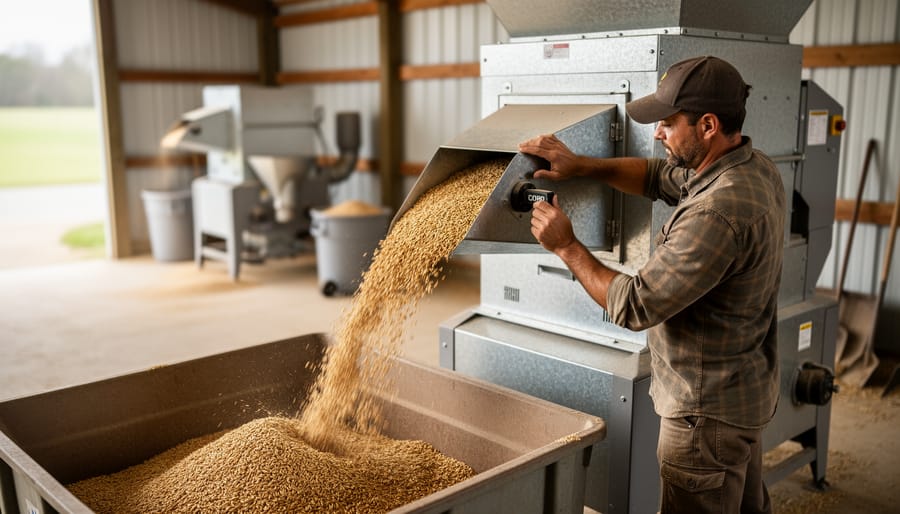
Intercropping is the technique of growing two crops together on the same field. After harvest, the LRHM uses a screening machine and gravity table to separate the legumes and cereals. Spiral separators, rotary drum separators or scalpers also could do the work.

Initially, the Sniders planned to improve the quality of their seed peas. Intercropped peas supported by cereal straw stayed standing and free of mildew. Stored together, the two seed types buffered the moisture when one was tough. Today, the family has 2,080 acres certified by the OCIA. They cultivate 1,600 acres. The rotation varies, but has roughly 675 acres of organic crops, 500 acres of green manure and 425 acres of hay. Organic wheat and rye stand alone. Other fields are always intercropped, always a legume (lentils, peas or fababeans) with a cereal (oats, barley, buckwheat or triticale). The intercropped legume and cereal need a close match in days to maturity. They also need the strength to survive disease and insect attacks that most growers control with crop protection chemicals.

All this narrows the seeding choices. "Older varieties seem to stand pretty good against disease and insects, but we do need research on which varieties are better suited to our system," he says. His best seed mix is triticale and fabeans. They mature about the same time and are shatter-resistant. Finding the right mix of barley or oats with peas is tricky. Some peas are prone to shattering. The cereal needs to mature before the pods dry and pop open. The Sniders use Radley green peas in a mix with either Derby oats or Bonanza or Klages barley. They also have a shorter-season yellow pea, First-And-Best, they can mix with Klages barley.

Steve uses green manure and organic fertilizer treatments or micronutrients blended with seed to fertilize his crops. Soft rock phosphate, mined and granulated in Idaho, is a key component. Sometimes he coats the seed with an emulsifiable ocean-based product from fish or seaweed. Steve's prepared seeding mixture ends up as a combination of two kinds of seed, an inoculant for the legume, plus micronutrients or an organic fertilizer. He puts it all in the ground with his 30-foot hoe drill in a single pass. "It's not too complicated," he says.

Plowdown issues
Early plowdown of "green manure" crops provides both fertility, and a measure of weed control. Steve's "green manure" is a blend of oats, barley, peas and fababeans. It puts fiber and energy back into the soil. "We put the four crops together to get as much competitive biomass as possible. We get a lot of tonnage per acre to turn under," he explains. He lets the legumes grow long enough to fix nitrogen for the next crop. Cereals add tonnage and boost competitiveness against weeds. They do the plowdown in late July with a 32-foot discer. They work the green manure 4 inches into the soil and disc it once more if required. Formerly 'conventional' land, added to the organic farm a few years ago, is more mellow soil and has more moisture retention. Steve says, "You don't pull up big lumps, and sandier stuff has less tendency to blow. When you do a plowdown every two or three years, you put back a lot of fiber."
Increased fiber counterbalances the moisture loss potential from tillage. Steve says, "Our soil has more fiber, so it holds more moisture."

Plowdown has its best results if there's a weed flush in early May. When that happens, Steve uses a cultivator and rodweeder in late May to kill the weeds. A day or two later, he's seeding down through a couple inches of dry soil. "The cereal will come shooting through and get ahead of the weeds. If the crop is ahead of the weeds by 4 to 5 days in June, it makes a world of difference in your dockage." He admits, "We do rely on having a weed flush before we seed. If it's dry or cold, the weeds aren't flushing. Then we wait and wait. That's hard for anybody."

Weed issues
Extremely dry conditions in 2001 and 2002 challenged all farming techniques in the region. The Sniders had some "extra" weeds, but it wasn't a major concern. Steve said, "They can be knocked back with a plowdown crop. Then, we'll be back to lower dockage." Weeds and neighbors, for the organic grower, can be a flash point. He tells visitors, "You never control weeds as an organic producer. You manage weeds. We strive to raise a crop that will out-compete the weeds. You want a dominant crop population, so the weeds are suppressed." He adds, "There's no excuse for a messy field."

Neighbors and rural officials sometimes see red when they see thistles drifting across the road from an organic field. "You've got to be very diligent," he says. "If you have a weed that's mobile, contain it as best as possible." He believes organic growers should go the extra mile to maintain weeds in the ditches. Regularly mow and tidy the ditches, Steve suggests. That kind of attitude will go miles in good relations, and will eliminate the need for roadside spraying that could be a problem for the organic grower.

Rotation issues
Crop rotations in an organic system can be complex. Steve has experimented once, over the years, with most of the options. The basic system that worked really well through the 1990s was a six-year rotation:

  1. Plowdown
  2. Fall rye
  3. Peas & oats
  4. Plowdown
  5. Wheat
  6. Peas & barley

"This rotation is very stable and seems to work very well for us," he says. Having five or six crops in the bins improves the supply of market opportunities and a measure of financial stability. Recent dry conditions pushed them to move into a 50/50 rotation between crops and plowdown. He says, "It's obviously good for the soil, but the farm's got to pay for itself. At this point, it seems to be holding its own."

Milling grade organic grains provide the highest returns per acre and per bushel. To date, by increasing the plowdown ratio, they're improving both quality and yield. Long term sustainability for the soil base seems well assured by the organic practices.

Sustainability for the family, on the farm, could be another issue. Steve says, "There's a lot of ways of looking at the economics and viability of family farms. I don't think there's one answer." Little Red Hen Mills doesn't produce the crop volume that a conventional family farm does in Alberta. However, it also doesn't have the same expenses. He says, "My risk is lower. My inputs are lower. We use our own seed. Our fertilizer cost is minimal. Our equipment cost is fairly low. Fuel is probably one of our higher inputs per acre." He accepts living with less yield per acre, but also gains substantial premiums for basic organic products, then cleans the products to milling grade for additional value. "None of us work off the farm," Steve adds. "This keeps us all here, and we're making a living."

Source:
Steven Snider
Little Red Hen Mills
New Norway AB
E-mail lrhm@telusplanet.net
Ph 780 855-2164
Cell 780 608-0905
Robert 780 855-2286


John Deitz is a consultant for the Organic Agriculture Centre of Canada. Please send comments or questions by phone to 902-893-7256 or by email to oacc@nsac.ca.


en français

Top

© 2011, Organic Agriculture Centre of Canada (OACC)