![]() |
![]() |
||||||
| About Us | Français | Top 10 | Partners | Donate | |||
| British Columbia | Prairies | Ontario | Québec | Atlantic | |||
| Research
Extension
Courses
Consumers
-------------------------- |
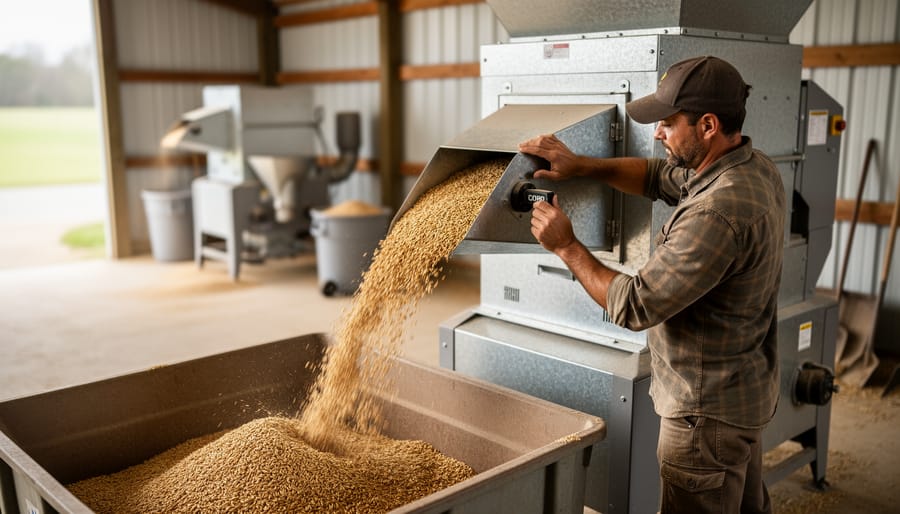
Organic Plant Breeding and Seed Production: Importance and ChallengesAv Singh, Ph.D. The National Standard of Canada for Organic Agriculture has recently been revised by the Standards Council of Canada and is available for viewing in its draft form. Significant changes in manure management and livestock welfare are noteworthy, but one area that may have widespread affect on the organic industry as a whole is regulations on seeds and planting stock (Section 6, subsection 6.3). Expectedly, the proposed standard encourages selection of varieties locally adapted with resistance to pests and diseases common to the area. However, new revisions limit the use of non-organically produced seeds. Farmers are required to use certified organic seed, bulbs, tubers, cuttings, annual seedlings, transplants when readily available. The suggested changes parallel a similar regulation in the United States Department of Agriculture's National Organic Program (NOP), but are less restrictive than the European regulation, which states that as of December 31, 2002 (a date which has been pushed back a few times) all propagating materials used in organic farming must be of organic origin. Few would argue that organic seeds aren't essential to organic farming. It makes logical sense that organic seeds are an integral component in maintaining system integrity and wholeness in organic agriculture. However, organic plant breeding and organic seed production are quite limited in their development. The Need for Organic Plant Breeding The different requirements for varietal characteristics clearly highlight the importance of breeding and selecting varieties suitable for organic farming under organic conditions. In several circumstances varieties that perform well in organic systems have different yield rankings than those that do well under conventional management. At the same time, it should be noted that organic breeding should not be limited to propagating varieties that have been produced by the conventional system and selling these on the organic market. The future of organic breeding may in fact include "organic varieties" bred solely for the intent of organic farming. Such programs would restrict, if not ban several breeding techniques including genetic engineering, cytoplasmic male sterility, and induced mutations, which would further limit the use of certain varieties and possibly certain crops. The Need for Organic Seed Production Traditionally, farmers saved a portion of their crops for their own seeds and occasionally to sell to neighbours. If the drafted regulations do pass, this practice will invariably increase and potentially become a viable source of additional income to many organic farmers. However, there are some important factors that should be considered. First, many of the conventionally bred varieties are patented or protected under the Plant Variety Protection Act and therefore may be propagated and sold only by companies licensed to produce the seed. A farmer may save enough seed of a protected variety for their own use but cannot sell to neighbours. Another restriction to on-farm seed production may be the requirement that seed used for organic production must be certified organic. In the past, organic farmers have often relied on fields in transition to produce "organic" seed, not only as a means towards self-sufficiency but an easy way of documenting that the transitional crop was separate from the organic crop. But, under current wording of the regulation this practice would be prohibited, if a readily available organic seed source was present. The Role of the Organic Agriculture Centre of Canada The OACC is working to coordinate similar research in western Canada with University of Alberta plant breeder, Dr. Dean Spaner, and University of Saskatchewan cropping systems researcher, Dr. Steve Shirtliffe. We also encourage organic farmers to contact the OACC directly to express their research needs, relevant to plant breeding and seed production or some other area of organic agriculture.
|
||||||
© 2006, Organic Agriculture Centre of Canada (OACC)