| Research
Extension
Courses
Consumers
--------------------------
Virtual
Farm Tours Student
& Job Opportunities News
Articles Links
Standards
--------------------------
Market
Information Events
Issues
Animal Welfare Strategic
Plans --------------------------
Award-winners
Kids
Stuff Rural
Culture Discussion
Forum Classified
Ads Weather
Site Map
|
Plan to Reduce Grasshopper Risk
Brenda Frick, Ph.D., P.Ag.


The grasshopper forecast for the prairies indicates severe risk in many
locations. Sound planning is the key to managing this grasshopper risk,
especially on organic farms.
Knowing a few things about grasshoppers will help make the planning easier.
First, grasshoppers aren't all bad. Grasshoppers are important in natural
ecosystems, efficiently converting grass to a high protein feed; they
are food for a variety of creatures from burrowing owls to coyotes. Of
nearly 100 grasshopper species on the prairies, only four are considered
serious pests. These four can be a problem because under ideal weather
conditions, they can take advantage of the conditions we create, and breed
and eat to excess (at least it seems excessive to us!).
This spring's grasshopper pests are hatching from eggs that were laid
last fall. The females mainly chose stubble fields, alfalfa, pasture,
marshes or roadside ditches to lay their eggs. Females generally don't
lay eggs in areas without plants, such as clean summerfallow fields.
Some species hatch in the fall, and spend the winter as "nymphs",
but these species are not a pest problem. The pest species all hatch in
spring, and thus are very small (0.5 in) when they emerge. They develop
only when temperatures in the soil around them are above 10°C. The
warmer temperatures get, the more quickly the little hoppers develop.
When the small grasshoppers emerge, they must eat or they will die. Only
after they have fed and grown, are they able to travel to distant fields.
This makes their first few days critical.
How can a producer take advantage of this vulnerability? There are both
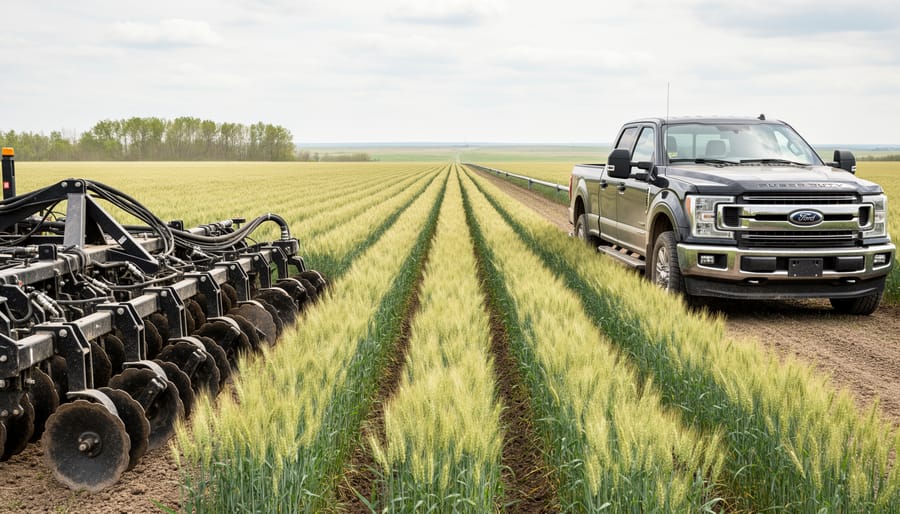
short and long term options. In the short term, spring tillage can be
helpful, to eliminate weeds and volunteers that are the food source as
grasshoppers hatch. Tillage in "hot spots" can be used to bury
eggs and nymphs deep enough to prevent their emergence.
Crop rotation is crucial. As most hoppers will emerge from stubble, crops
seeded on stubble are most at risk. If the grasshopper risk in your area
is severe, it would be wise to seed something grasshoppers don't like
on these areas. Possibilities include chickpea, field pea, mustard, oat
or B. rapa canola. On clean summerfallow, cereals might be considered.
Lentil seems to be particularly vulnerable, and might be considered only
if the risk is low and other precautions are undertaken.
Barrier or guard strips of up to 30 ft can be seeded around high value,
higher risk crops. These strips might include the non-preferred crops:
chickpea, oat, mustard, field pea. The idea would be to discourage grasshoppers
from crossing through the crop they dislike to get to the crop they do
like, something like hiding the dessert table behind the salad bar.
If grasshoppers emerge in ditches near crops, the crops can be protected
by a barrier strip of up to 30 ft of tilled land. This can be effective
at stopping the very young grasshoppers from feeding in the strip, and
thus reaching the main part of the field. Older grasshoppers are more
likely to cross a tilled strip, so seeding the strip to field pea or some
other less preferred crop, later in the spring is recommended to keep
the strip undesirable to grasshoppers.
Early seeding is recommended in high risk grasshopper areas. Crops that
are seeded earlier, and therefore are larger when grasshoppers arrive
to feed, are more able to survive the damage. Older crops will also be
less attractive to migrating grasshoppers later in the season.
For some producers, crop insurance will be part of the risk management
plan. Crop insurance requires that all producers, whether organic or conventional,
attempt to reduce risk from grasshoppers through management practices.
Therefore, it may be helpful to discuss your management plan with your
local crop insurance office this spring, to avoid problems later.
In the long term, rotations are especially important. A diverse mix of
crops, weeds, shelterbelts, and natural areas on the farm, will increase
the diversity of insects found on the farm. This diversity may include
some important predators or pests of grasshoppers that are causing cropping
problems. Dan Johnson, entomologist and ecologist at the Agriculture and
Agri-Food Research Station at Lethbridge, says that "after the direct
effects of weather on reproduction, growth and survival, the grasshoppers'
natural enemies are the most important factor in controlling grasshopper
populations. Weather affects insects like grasshoppers gradually, and
also through extreme events. Natural enemies of grasshoppers are widespread,
and with the right conditions they can be effective in the hastening the
decline of grasshopper populations."
Grasshoppers are another reminder that nature works in cycles. In hot
dry years, the grasshoppers can get ahead of their enemies. In cool wet
years, the natural predators and parasites will get the better of the
grasshoppers. Our extensive cereal cropping feeds the population booms
in grasshopper cycles. By increasing biodiversity, by maintaining natural
areas, expanding crop rotations and through relaxed weed control, perhaps
we can help foster the balance in the systems that sustain us.
For more information, see Grasshopper Management, March 2003,
AGRI-FACTS Agdex 622-27, Alberta Agriculture, Food and Rural Development.
AND Understanding Premiums & Causes of Loss, Agriculture and Agri-Food
Canada and Saskatchewan Crop Insurance Corporation.
Grasshopper forecast maps can be viewed at the following websites:
http://www.gov.mb.ca/agriculture/crops/insects/forecast/grasshopper_map.html
http://www.agr.gov.sk.ca/
http://www.agric.gov.ab.ca/app21/rtw/index.jsp

Brenda Frick, Ph.D., P.Ag., is the Prairie Coordinator for the Organic
Agriculture Centre of Canada and is located at the University of Saskatchewan.
She welcomes your comments at 306-966-4975 or via email
brenda.frick@usask.ca
Click
here for futher information about grasshoppers
This article first appeared in
The Western Producer, and is published here on the OACC website with
permission.
|