Energizing Pastures and Grazing Cows
By Rupert Jannasch, M.Sc., P.Ag
Management Intensive Grazing (MIG) is a productive and sustainable method
of pasture management that is very adaptable to organic farming. Success
with grazing, however, demands efficient use of pasture forage without
compromising the nutritional needs of the cow. High producing dairy cows
do not flourish on pasture on their own - their digestive systems must
be tweaked to maintain good milk flow. Transitional organic farmers not
used to grazing, as well as novices, must pay attention to detail so as
not to find all their cows' ribs showing when the grazing season ends.
The Pasture
The first rule of pasture is to treat it like a crop rather than an exercise
yard. The sward should be kept in an immature and highly digestible state
of growth for as much of the summer as possible. For a typical grass/white
clover sward in a humid areas this means getting the animals on pasture
early to keep the grass in check, and maintaining an entry height before
grazing of 15-20 cm and an exit height after grazing of 5-10 cm.
Exit heights are important because the sward should be grazed evenly
to avoid waste while leaving enough leaf area to promote fast regrowth.
The tendency for cows to select the juiciest feed needs to be controlled
by parceling out a little more than enough feed for them to eat their
fill. A 12 or 24 hour grazing period is ideal.
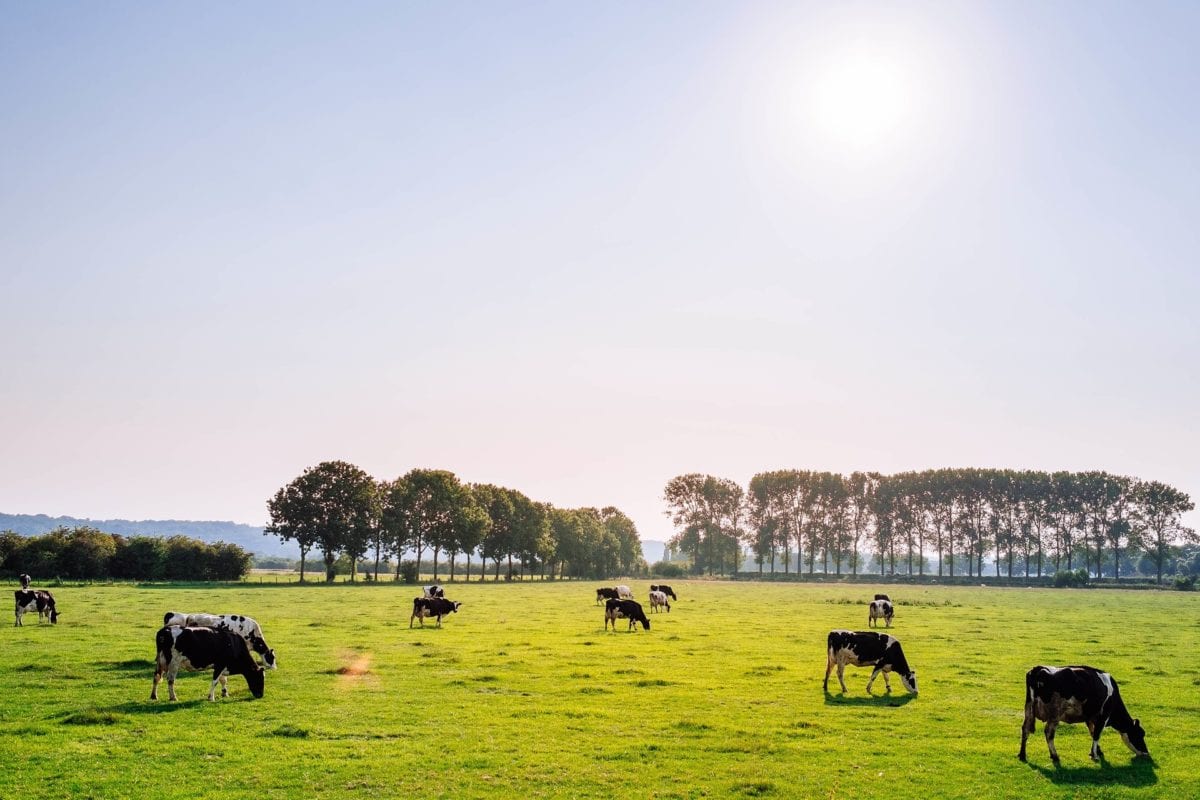
MIG pastures can be grazed up to 7-10 times per season with dry matter
(DM) yields upwards of 5 t/ha and percent Acid Detergent Fibre ranging
from 28-30 (DM basis). The trick is how to best utilize the feed. If cows
are fed too much supplementary feed at milking, the cows may not be hungry
when they go to graze.
The Cow
The problem encountered most often during the grazing season is a shortage
of energy. Symptoms include above normal decreases in body weight and
declines in body condition. Although cows may continue to milk well, excessive
weight loss may adversely affect reproductive health, milk crude protein
(CP) concentration and milk production in the current or following lactation.
Consider that a 600 kg Holstein cow eats about 3.5 to 4 percent of its
own body weight in DM each day - about 20-24 kg. Estimates of DM intake
when grazing range from 12-18 kg per day. Pasture will usually provide
enough energy for about 20 kg of milk per day. That's about half of what
a high producing Holstein requires in early to mid-lactation.
An easily digestible energy source is essential to fully utilize the
nitrogen released in the rumen and prevent excessive ammonia formation.
Organic farmers will feed mixed grains (50 percent barley, 50 percent
oats) up to a maximum of 7-8 kg per day. Certified organic dairy concentrates
are becoming available, but they can be expensive.
At Kipawo Holsteins, a semi-organic farm near Wolfville, Nova Scotia
(no N-P-K fertilizers or pesticides used for 15 years; avg. milk production
9000 kg per cow) Herman Mentink practices MIG and feeds a mixture of haylage
and corn silage year round. Conventional dairy concentrate (14% CP) is
fed at the rate of 1 kg per 4.5 kg milk during the grazing season. Cows
producing more than 23 kg milk per day are fed between 0.5 and 3 kg of
additional protein and energy supplement (32% CP).
Organic dairy farmer, Lawrence Andreas, near Tiverton, Ontario, supplements
grazing Holstein cows with a haylage-based Total Mixed Ration with 2-4
kg mixed grains per cow per day. An additional minimum of 2 kg hay are
fed per cow per day to ensure proper rumen function. For additional dietary
fibre Andreas recommends cows graze semi-mature forages - say at entry
heights of 25 cm - as opposed to the shorter, more immature forage described
above.
Comparing the production strategies on the Mentink and Andreas farms
reveals that milk production at Mentinks increased by about 660 kg per
cow during the 1990s as the herd became more reliant on grazing (see Lynch
et al. below). The amount of supplements fed increased as milk production
went up, yet feed costs per litre of milk declined from 14.3 cents to
11.6 cents over a ten year period.
At the Andreas farm, fewer concentrates are fed and average milk production
has actually been scaled back from a peak of over 10,000 kg per year ten
years ago to a more modest average in the 8500 kg range. Lawrence Andreas
believes that reduced metabolic stress and fewer health and reproductive
complications make up for lower milk yields and promote higher lifetime
production from his cows.
Supplementary feeding for grazing organic cows is a necessary, but tricky
business. As milk yields increase more concentrates must be fed, and this
can be challenging in terms of herd health, as well as being expensive.
To avoid having pasture play second fiddle to in-barn feeding, there may
well be a limit to expectations for total milk production from organic
dairy cows on pasture.
(The importance of micronutrients and other dietary supplements will
be discussed in a later article in this series)
Further reading:
Lynch et al. 2003. Improving the nutrient status of a commercial dairy
farm, an integrated approach. American Journal of Alternative Agriculture,
18(2):1-9.
Fredeen et al. 2002. Productivity of Grazing Holstein Cows in Atlantic
Canada. Journal of Dairy Science, 85:1331-1338.
Rupert Jannasch, M.Sc., P.Ag. is a consultant for the Organic Agriculture
Centre of Canada. Please send comments or questions by phone to 902-893-7256
or by email.
|