First organic feed mill in Atlantic Canada
By Barbara Scott
One of the pieces missing in the development of the Atlantic organic
industry will be filled in this fall when the Sussex Co-op in New Brunswick
starts producing organic feed.
Until now, organic farmers had to buy feed from Ontario or Quebec,
and grain growers had to send their crops outside the region for processing.
“Having to get feed from markets outside our region has been
a definite stumbling block for farmers,“ said Beth McMahon.
“There are very few certified organic farmers in Atlantic Canada
compared to
other
parts of the country. I’m sure that having this local supply for
feed will encourage others to get involved in organic farming because
of reductions not only in transportation costs, but also in the amount
of time it takes to get delivery of the product,” the Atlantic
Canadian Organic Regional Network (ACORN) executive director said.
Ecocert, an internationally recognized control and certification organization,
recently certified the Sussex Co-op to manufacture organic feed. The
Co-op will begin mixing organic feed with this fall’s harvest.
General Manager Dave Arsenault said it will be able to source almost
all ingredients within the region, except for soybean meal and corn
on occasion.
The Co-op will begin mixing organic formulas one day every two weeks
but Arsenault expects production will gradually increase. He estimates
orders could quadruple within the next few years. “There is an
increasing demand for organic feed and a growing desire among farmers,
and dairy processors in particular, to enter into the organic market
in Atlantic Canada.”
There are now only 170 certified farms and processors in the region.
Many farmers want a product that is both local and organic. Since this
hasn't been an option, many potential buyers have opted for local, McMahan
said.
“Several certified farms have opted to not certify livestock
because of the prices of organic feed. We believe that these farms will
be prompted to reconsider this decision when the local organic feed
becomes available.”
She added that organic farmers have been upset by the additional shipping
costs getting their crop to Ontario and back. The distance has caused
frustrations because products take longer to arrive, sometimes up to
two weeks from the order date.
The Sussex Co-op has the capacity for storing and distributing organic
grains throughout the region. At present Co-op Country Stores collect
orders that are sent to Ontario. When the local product becomes available,
buyers will be able to order and pick-up through their Co-op Country
Store, Arsenault explained.
He noted that cutting down the shipping distances should have a positive
environmental affect, reducing greenhouse gas emissions. Grain growers,
too, are looking for markets closer to home that reduce their transportation
costs.
ACORN has organized a "Maritime Organic Grains Network" with
the Organic Agriculture Centre of Canada, which already has 200 members.
(There is no charge to join.) McMahan has noticed a marked interest
from conventional growers to tap into the organic market. “Now
with a local buyer, combined with our initiative to provide research
and market information, we foresee that organic grain production will
continue to grow over the next several years.”
OACC gratefully acknowledges the author and Atlantic
Farm Focus for permission to post this article
on our website.
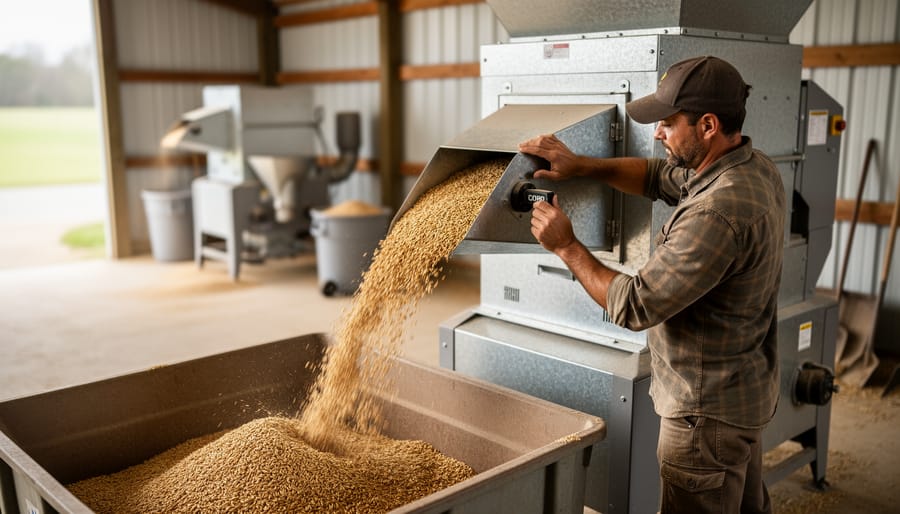
Photo courtesy of Barbara Scott: Sussex Co-op Feed Mill Supervisor
Fran Simpson and lead hand Lloyd Simpson (no relation) discuss changes
in feed formulation for organic feeds.
Posted October 2008